
If you’re not sure where to go, check these out! Recommended spots for different purposes in Ueno Park
Ueno Park, Japan's oldest park, opened in 1873. Its vast grounds, equivalent to about 11 Tokyo Domes, are dotted with cultural facilities, historical buildings, monuments, sports facilities, and more. With so many things to see, many people may find it difficult to decide where to go. In this article, we'll introduce recommended spots by purpose. We've picked out places unique to Ueno Park, such as pandas and power spots.
Outline
Access from the hotel to Ueno Park

Take the JR Tokaido Line from Kawasaki Station directly to Ueno Station. Exit through the Koen Exit ticket gate.
Travel time: approximately 30 minutes
Fun for both adults and children! Meet the pandas at Ueno Zoo

Ueno Zoological Gardens (hereafter: Ueno Zoo) is the iconic symbol of Ueno and is renowned as the place where visitors can meet the pandas. It is a fantastic spot where everyone—from families with children to couples and friends—can enjoy a relaxing stroll while taking in the rich nature of Ueno Park.
Ueno Zoo features three main entrances. In addition to the Main Gate, which is about a five-minute walk from the JR Ueno Station Park Exit, there is the Benten Gate, easily accessible from the JR Ueno Station Shinobazu Exit and Keisei Ueno Station, and the Ikenohata Gate, which is close to Nezu and Yushima. For this visit, we will start from the Main Gate and proceed through the East Garden before heading to the West Garden.

Upon passing through the Main Gate, you will immediately see the “Kyukan’ei-ji Temple Five-Story Pagoda” on your left. Originally burnt down and rebuilt in 1639, this structure is designated as an Important Cultural Property ($\ast 1$). Its height, from the ground to the crown, is approximately 36 meters. It is a striking example of historic architecture standing within Japan’s first-ever zoo ($\ast 2$).
*1: See the ” Agency for Cultural Affairs Nationally Designated Cultural Properties Database
“*2: See the ” Ueno Zoo Official Website: History of Ueno Zoo
“*3: See the ” Ueno Zoo Official Website: Highlights of Ueno Zoo
“*3: Information current as of March 2024

This is the Sumatran tiger, native to the island of Sumatra in Indonesia. It is characterized by its relatively small size compared to other tiger subspecies.Sadly, due to the development of its forest habitat and excessive hunting by humans for its fur, its population has plummeted, and it is now listed as an internationally protected species ($\ast$).
* See the Ueno Zoo official website

Surya, an Asian elephant, weighs over 3 tons! We were able to witness him skillfully using his long trunk and the pole of the door to eat grass.

The fan service was also excellent! When I pointed my lens at them, they looked directly into the camera.
Meanwhile, the West Garden is a scenic area situated on the north side of Shinobazu Pond. In addition to the Panda Forest where the giant pandas reside, it also houses African animals such as giraffes, hippos, rhinoceroses, and aye-ayes.

Here is the ever-popular, famously motionless shoebill. On the day of our visit, it looked thoughtful and didn’t move a single muscle.
Its characteristic stillness comes from its hunting strategy: patiently waiting for the moment when large fish, such as catfish and lungfish, rise to the surface so it can prey on them.

The red pandas were full of energy, running around in circles in their enclosure! They are typically most active in the early morning and evening, often spending the daytime sleeping in trees or holes. Their devoted expressions are truly heart-warming!
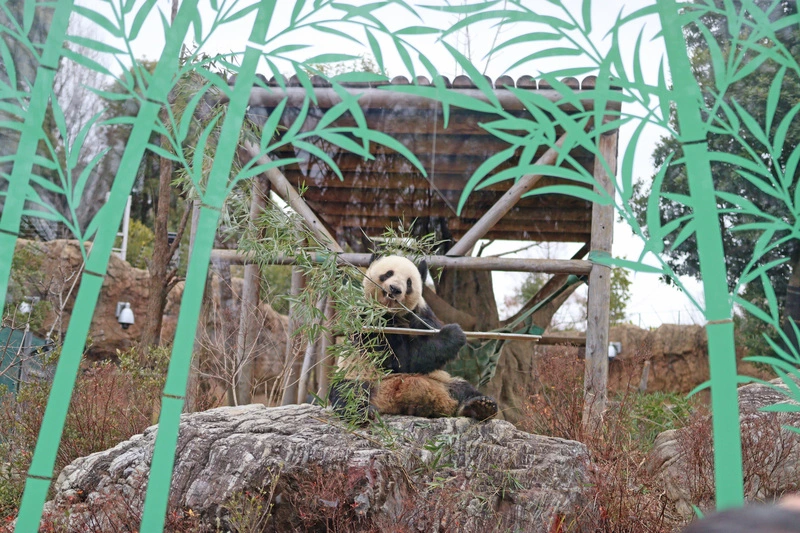
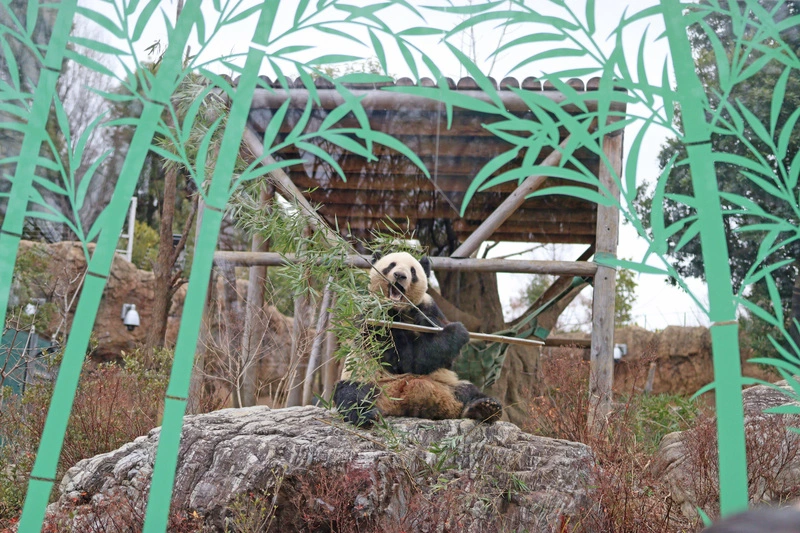
Finally, we headed to the Panda Forest. We were lucky enough to see the adorable female panda, Lei Lei! Unfortunately, her twin, the male panda Xiao Xiao, was in a different outdoor enclosure, so we weren’t able to meet him on this visit.The typical wait time to see the pandas is about 20–40 minutes on weekdays and about 60–90 minutes on weekends and holidays ($\ast$).On this day, Lei Lei was munching on bamboo with great gusto. Every year around April and May, Ueno Zoo feeds the pandas bamboo shoots harvested from the neighboring Ueno Toshogu Shrine. It’s wonderful to see how the animals in Ueno Park benefit directly from the natural beauty of the surrounding area.
(*Information current as of April 2025.)

Perhaps due to its connection to pandas, the “Panda Bun” sold at Cafe Chameleon near Panda Forest is a steamed bun filled with plenty of bamboo shoots.It looks so cute, it took me a while to eat it! It’s palm-sized and perfect for when you’re feeling a little hungry.
Don’t miss the panda goods on sale at the zoo shop!

Clockwise from the right: “Exhausted Panda Cub” 1,980 yen (tax included), “Pony Panda” 693 yen (tax included), “Sticky Note Set Xiao Xiao & Leilei” 418 yen (tax included), “Fair Trade Cotton Towel Xiao Xiao & Leilei Green” 825 yen (tax included) (*).Be sure to check out Xiao Xiao and Leilei goods.*Information current as of April 2025. Items may be sold out.
[Overview of Ueno Zoological Gardens]
[Address] 9-83 Ueno Park, Taito-ku, Tokyo
[Telephone] 03-3828-5171 (9:30-17:00 / Closed on Mondays)
[Price] Adults 600 yen, 65 years and over 300 yen
, junior high school students 200 yen (free for junior high school students who live or study in Tokyo), free for children up to 6th grade
[Opening hours] 9:30-17:00
*Admission and sales of admission tickets and annual passes are available until 16:00
*Ikenohata Gate opens and tickets are on sale from 10:00
[Closed] Mondays (if Monday is a national holiday, a substitute holiday, or Tokyo Citizens’ Day, the park will be closed the following day),
New Year’s holidays (December 29th to January 1st of the following year)
*There is a possibility of some changes, so please check
the official website for details
Wishing to receive the blessings of a power spot! Be enchanted by the golden shrine building at Ueno Toshogu Shrine

Speaking of power spots in Ueno Park, there’s Ueno Toshogu Shrine, which was founded in 1627 (*).”Toshogu Shrine” is a shrine dedicated to Tokugawa Ieyasu (Tosho Daigongen), and there are said to be many of them across the country, such as in Nikko and Kunozan (*).Ueno Toshogu Shrine is said to grant blessings for career advancement, victory, and good health and longevity (*). Just looking at the Karamon gate from the main approach to Ueno Toshogu Shrine gives you a sense of its majesty. When you quietly put your hands together, you even feel as if you’re being filled with power.
*See the ” Ueno Toshogu Shrine Official Website “
Ueno Toshogu Shrine official website

The first thing that catches your eye when you enter the shrine grounds is the sacred tree “Okusu” (*), which has a trunk over 8 meters thick and is said to be the ancestor tree of the shrine, about 600 years old.In front of it is the “Silence Hall,” a building created for visitors to face the sacred tree and calm their minds before worshiping at the shrine. I took off my shoes, sat upright, and spent a quiet moment there.
*See the ” Ueno Toshogu Shrine Official Website “

Finally, we entered the Karamon Gate. The “See-through Wall” that surrounds the shrine, built in 1651, is a nationally designated important cultural property (*).The upper level features lively carvings of animals and plants from the mountains and fields, while the lower level features creatures from the sea and rivers, and I found myself fascinated for a while. When I saw the monkey carving, I was reminded for a moment of the “Three Wise Monkeys” at Nikko Toshogu Shrine.
* See the” Ueno Toshogu Shrine Official Website “

The shrine building, also known as the “Golden Hall,” is covered in gold leaf and is truly magnificent. It was built in the same year as the see-through fence (*1) and is a Gongen-style building consisting of three rooms: the worship hall, offering hall, and main hall (*2).The Golden Hall is not only known for its beauty, but also as a fortunate building that has overcome many hardships, such as the Great Kanto Earthquake and the Tokyo air raids (*1). It is truly miraculous that it has survived in the same form as it did in the Edo period!
*1: See Ueno Toshogu Shrine official website
*2: The interior of the shrine building is not open to the public

The mobile phone stand set up in front of the Golden Hall was very convenient for taking photos and was very appreciated!

Outside the gate, near the main approach, there are many things to see, such as copper and stone lanterns, a Kagura hall, and more. There is also a unique corner where you can measure your height using shaku (Japanese scale).
Ueno Toshogu Shrine official website

The “Peony Garden” within the shrine grounds hosts the “Ueno Toshogu Shrine Winter Peony” (*1) every year from January 1st to late February, and the “Spring Peony Festival” from early April to early May (*2).*1: In 2025, it was held from January 1st (Wed) to February 24th (Mon), 2025.
*1: See the ” Ueno Toshogu Shrine Official Website”
*2: In 2025, it was held from April 5th (Sat) to May 6th (Tue), 2025.
*2: See the ” Ueno Toshogu Shrine Official Website “

These are winter peonies. On a chilly day, just one glance at their lovely appearance instantly brightened my heart.
[Ueno Toshogu Shrine Overview]
[Address] 9-88 Ueno Park, Taito-ku, Tokyo
[Telephone] 03-3822-3455 (Shrine office) / 03-3822-3575 (Peony Garden)
[Price] Adults 500 yen, elementary school students 200 yen, preschoolers free
*Peony Garden Adults (middle school students and above) 1000 yen
[Opening hours] 9:00-16:0
0[Closed] Open every day
Enjoy traditional flavors in a relaxing atmosphere! Lunch and tea time at Forestille Seiyoken

Tokyo Bunka Kaikan (*) is a masterpiece by Kunio Maekawa, a pioneer of modern architecture. On the second floor of the concert hall, which can be said to be the face of Ueno, there is a spacious Western-style restaurant.
* See the Tokyo Bunka Kaikan official website
Tokyo Bunka Kaikan official website

“Forestille Seiyoken” is a sister store of “Ueno Seiyoken Main Store” located in Ueno Park (*). The spacious space is completely made of glass, and you can see the interior from the 1st floor entrance lobby and foyer, which is a testament to the fine architecture.
* See ” Ueno Seiyoken Official Website “
Forestille Seiyoken official website is here

First, I ordered the “Fluffy Omelette Rice with Hayashi Sauce” for 1,950 yen (tax included) (*).*Information as of April 2025*For details on the menu, please check

The beef in the hayashi sauce is surprisingly tender! It’s so soft that you can easily put a spoonin it. The fluffy egg and the buttery ketchup rice create a wonderful harmony.

This is the American-born Chinese dish “Chop Suey” for 1,780 yen (tax included). Forestille Seiyoken has been serving it as a “bouillon-based Western dish” since the opening of Tokyo Bunka Kaikan in 1961 (*).There are various theories about the origin of chop suey, but it is said to have become popular when Cantonese cuisine was brought to America and adapted to local tastes (*), and it has a light and familiar taste. It is filled with plenty of ingredients such as shrimp and vegetables, so it is very filling.
* See the Forestille Seiyoken official website


After the meal, I chose the “Apple Cake” for 750 yen (tax included). The crisp texture of the apples contrasted with the sweet and sour taste of the fluffy custard cream, leaving a refreshing aftertaste.The “Chocolate Cake” (750 yen, tax included) made with couverture chocolate is smooth and delicious. The cake is made up of many layers, and is impressive for its complex flavor and richness.
[Restaurant Forestille Seiyoken Overview]
[Address] Tokyo Bunka Kaikan, 5-45 Ueno Park, Taito-ku, Tokyo
[Telephone] 03-3821-9151
[Business hours] 11:00-17:00 (Last orders 16:30) or 11:00-19:00 (Last orders 18:30)
*Business days and hours may vary depending on the performance date
*Please check with the facility for details
Forestille Seiyoken official website is here

Ueno Park is home to a collection of splendid “famous Showa-era architecture.”In front of the Tokyo Bunka Kaikan, which we introduced earlier, stands the National Museum of Western Art, a structure left behind in Japan by
French architect Le Corbusier, the mentor of Maekawa Kunio (*). Completed in 1959, it was registered as a UNESCO World Heritage Site in 2016 (*).Le Corbusier summarized the five key elements that make up modern architecture. These elements are “pilotis,” “rooftop gardens,” “free floor plans (floor plans),” “horizontal windows (horizontally continuous windows),” and “free elevations (facades).
” *See the” National Museum of Western Art official website “
National Museum of Western Art official website

This is the pilotis. The structure of the first floor, which has no walls and is held up by pillars alone, is connected to the outside while providing a spacious space.Other attractions include the National Museum of Nature and Science, with its impressive modern tiled floors, the Tokyo National Museum with its beautiful gardens, and the Tokyo Metropolitan Art Museum, designed by Kunio Maekawa (*). Ona nice day, enjoy exploring the architecture that can only be found in Ueno Park.
* See the Tokyo Metropolitan Art Museum official website
[Overview of the National Museum of Western Art]
[Address] 7-7 Ueno Park, Taito-ku, Tokyo
[Telephone] 050-5541-8600 (Hello Dial)[Admission] Adults 500 yen, University students 250 yen (Permanent exhibition) *Special exhibitions are subject to additional charges
[Opening hours] 9:30-17:30
Friday and Saturday 9:30-20:00
*Entry is closed 30 minutes before closing: Mondays (closed on public holidays and closed the following weekday), New Year’s holidays (December 28th-January 1st)*There may also be other temporary openings and closings
Related Articles

[Kanazawa] An Ideal Destination for Business and Girls’ Trips! “Torifito Hotel & Pod” is Conveniently Located for Sightseeing
With the opening of the Hokuriku Shinkansen, the Hokuriku area has become even more accessible, making Kanazawa closer than ever. Our team heard about a very convenient hotel in Kanazawa and in this article, we’ll introduce it along with accommodations and nearby sightseeing attractions. Whether it’s for a business trip or a girls' trip, you can plan a dedicated itinerary, and it's also possible to bring your pets! Please take a look at this versatile hotel.
Information: This service uses affiliate advertising Provided by: Torifito Hotel & Pod Kanazawa Hyakumangokudori

[Ishigaki Island] Spend your Golden Week at ‘cafe & bar sazanami’! Enjoy BBQ, sauna, and SUP to the fullest
'cafe & bar sazanami' is an outdoor resort facility where you can enjoy activities set against the natural beauty of Ishigaki Island — all in one place, including BBQ, sauna, a seawater pool, and SUP. If you want to make the most of your Golden Week on Ishigaki Island and "pack in as much as possible in a single day," this is the place for you. If you haven't decided on your Ishigaki Island Golden Week plans yet, be sure to check this out!
A slightly special night out at ‘Premium Karaoke MODIS Shibuya’! Fully private room plan with bar counter
Premium Karaoke MODIS Shibuya is the perfect karaoke spot for those who want "something a little more special than the usual izakaya." The "Casual Lounge Plan" guarantees a fully private premium room complete with a bar counter. The plan includes a 5-course meal supervised by the head chef and all-you-can-drink options, making it ideal for a wide range of occasions — from after-work gatherings and girls' nights to mixer parties and farewell parties. Spend 2 hours enjoying yourselves at your own pace, without worrying about those around you.
-300x200.jpg)
About a 5 minute walk from the station! Grids Premium Osaka Namba, a stylish hotel that is easy to visit
This article introduces "Grids Premium Osaka Namba". It is a hotel that can be used as a base for sightseeing because it is conveniently located about 5 minutes on foot from the station and has easy access to sightseeing spots! There are plenty of facilities and equipment that allow you to fully enjoy your stay at the hotel, such as spacious guest rooms without dormitory types, a restaurant where you can enjoy a rich breakfast to start your day, and a cafe where you can enjoy a menu using seasonal fruits in an open space. We will dig deeper into the charm of Grids Premium Hotel Osaka Namba! Provided by: Grids Premium Osaka Namba

Looking for a birthday party in Shibuya? Karaoke Pasela Shibuya is the perfect choice! Enjoy creating your dream birthday together!
Karaoke Pasela Shibuya is a spot where you can enjoy birthday parties and fan activities in a private room, located about a 2-minute walk from Shibuya subway station. The Shibuya store's exclusive "Self-Produced Birthday Plan" allows you to enjoy your ideal birthday party by creating it yourselves! You are guaranteed a full 4 hours in the "Birthday Neon Room," complete with neon signs, chandeliers, and teddy bears. You can bring your own cakes and drinks or order them on the spot, making it highly flexible. This article introduces a special time spent in a space that is sure to be Instagrammable.